
Most people who need a piece of metal do not need a metallurgy textbook. They need to know which shape exists as a standard mill product, what the grade designation on the tag means, whether 16 gauge is thicker or thinner than 14, and why the same nominal bar costs and behaves differently depending on how it was finished. This site is a reference desk for exactly those questions.
MetalsForASteel.com indexes the six material families that make up almost all general-purpose stock — hot rolled carbon steel, cold finished steel, stainless steel, aluminium, tool steel and brass — and the mill forms each one is produced in. Every entry is written for the person holding a drawing, not for a buyer being sold to.
Independent reference. MetalsForASteel.com is an independent, non-commercial reference on metal forms, grades and mill processes. It sells nothing, quotes nothing and takes no orders, and it is not affiliated with, endorsed by or connected to Boone Steel LLC or any metal supplier, distributor or mill.
The six families, in one paragraph each
Hot rolled carbon steel is formed above its recrystallisation temperature, which is why it is the cheapest and most widely stocked material and why it arrives with a dark blue-grey mill scale and softly rounded corners. It covers structural angle, channel, beam, flat bar, round bar, sheet, plate, pipe and tube. Dimensional tolerances are loose by design. See hot rolled steel.
Cold finished steel is hot rolled stock that has been pickled and then drawn, turned or ground at room temperature. The extra operation buys a bright surface, sharp corners, tighter tolerances and higher yield strength, at the cost of internal stress that can move the part when you machine it asymmetrically. C1018, 1045 turned-ground-and-polished round, and 4140 alloy live here. See cold finished steel.
Stainless steel is any of a large family of iron alloys carrying at least about 10.5% chromium, which forms a self-repairing passive oxide film. In general stock the practical choice is between 304, 316 and 430. See stainless steel.
Aluminium is a third the density of steel, does not rust, conducts heat and electricity well, and comes in alloy families with wildly different personalities — 6061 machines and welds, 6063 extrudes into clean architectural profiles, 5052 forms without cracking, 3003 is the cheap general sheet. See aluminium.
Tool steel is bought by hardening behaviour rather than by shape: air-hardening A2, oil-hardening O1, water-hardening W1, and high-carbon high-chromium D2. It is stocked as drill rod and as precision ground flat stock. See tool steel.
Brass — copper alloyed with zinc — is stocked mainly as free-machining C360 rod and bar and as C260 cartridge brass sheet. It cuts beautifully, takes a polish, and is non-sparking. See brass and copper alloys.
Forms before grades
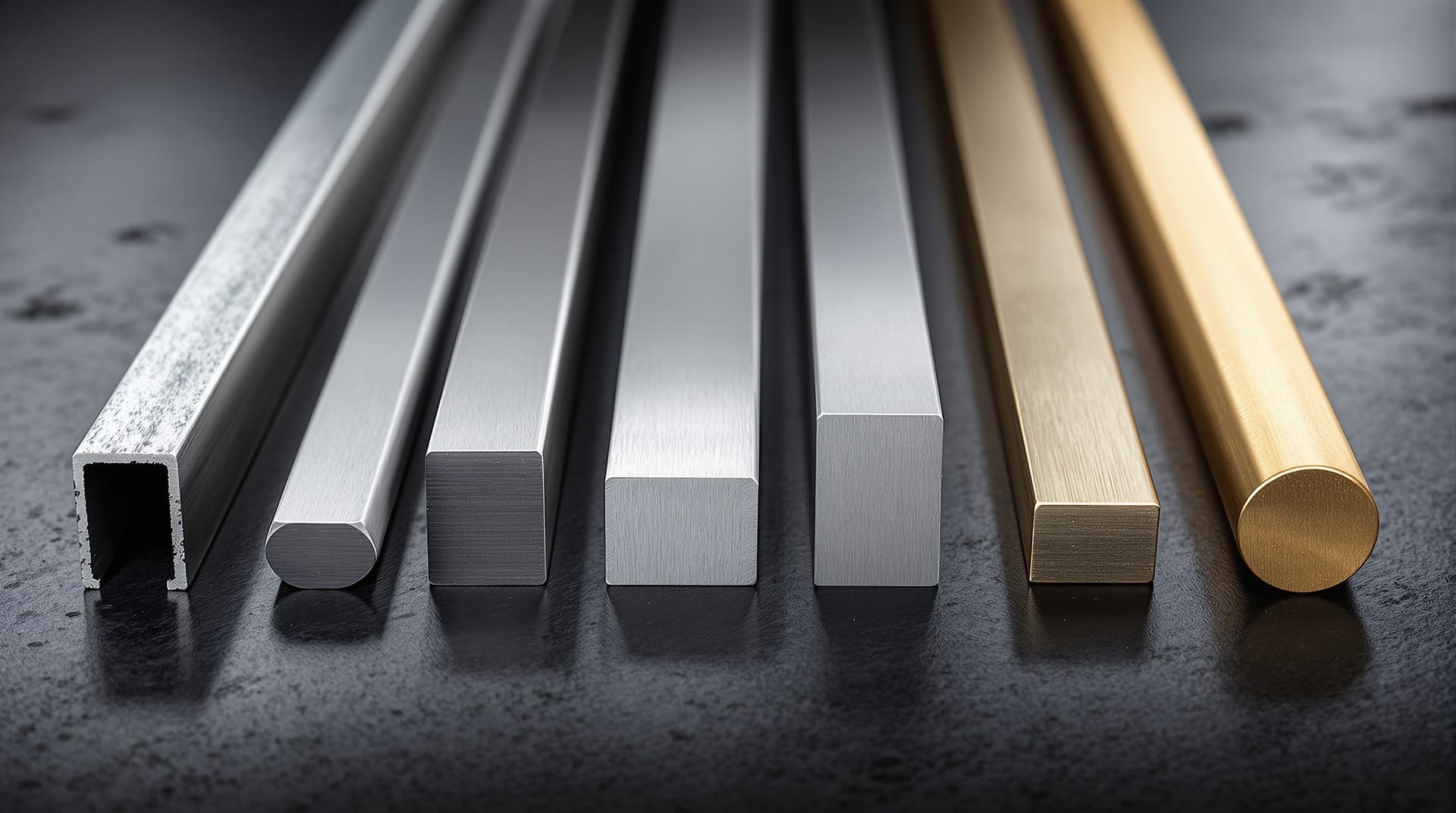
The single most useful habit when specifying stock is to settle the form before arguing about the grade. A form is a mill product: angle, channel, beam, flat bar, round bar, square bar, hexagon, sheet, plate, pipe, structural tube, expanded metal, grating, threaded rod. Each form is produced on particular equipment in particular size ranges, and that is what decides whether a size exists at all.
The full list of forms this reference covers, organised by material family, is in the form catalogue. A condensed one-page version — the kind of summary a service centre would once have printed on card — is on the stock forms line card.
Reading a size call-out
Stock metal is described in a handful of conventions that are inconsistent with one another, which is the source of most ordering mistakes:
- Bar and angle are called out by cross-section then length: 2 x 2 x 1/4 angle is two-inch legs with a quarter-inch thickness.
- Sheet is called out by gauge number, which decreases as thickness increases, and which is a different series for steel, stainless and aluminium. Above about 3/16 inch the material is called plate and is quoted in decimal or fractional thickness instead. The sheet and plate reference sets the series side by side.
- Pipe is called out by nominal size and schedule — the nominal number is not the outside diameter, and the schedule sets the wall. Tube is called out by actual outside dimension and wall thickness. A 1-1/4 inch schedule 40 pipe has a 1.660 inch outside diameter; a 1-1/4 inch round tube has a 1.250 inch outside diameter. They are not interchangeable.
- Threaded rod is called out by thread designation and length.
How stock is processed
Very little metal leaves a service centre in the length it arrived. The standard operations — shearing, saw cutting and mitering, punching, brake forming, and oxyfuel, plasma or laser burning — each impose their own limits on thickness, edge quality and squareness, and each leaves a signature you can read on the cut face. What a metal service centre does walks through the processing chain and what each operation can and cannot hold.
Where the shapes end up
The reference is more useful when the abstractions are attached to real objects. Uses of metals traces flat bar into fencing and strapping, drawn-over-mandrel tube into roll cages, beam into building frames and crane booms, and angle into trailers and masonry lintels.
Longer technical notes live in the articles index, including detailed treatments of drawn-over-mandrel tubing and free-machining grades.
About the reference
Nothing here is a specification. Grade designations, dimensional series and process limits are summarised for orientation and change over time; the governing documents are the ASTM, SAE, AISI and ASME standards themselves, and material certification for any specific piece comes from the mill test report that accompanies it. For the underlying metallurgy, ASM International is the standing authority, and the general mechanics of rolling are well covered in the open literature.
More on scope, sourcing and independence is on the about page.